
- Purpose
- Scope & Access
- Operating Assumptions
- Club Boats Available
- Crew Competence and Qualifications
- Boat Selection Guidance
- Capstan midweek sailing
- Informal training events
Purpose
To provide guidance on the selection and deployment of club boats in support of on water activity. This gudance is intended to ensure safe and effective race management and appropriate safety cover for all activity on the water in accordance with recognised good practice and RYA principles.
Scope & Access
Applicable to all personnel participating in water activities. Boats are for authorised, organised events only and may not be used by individual members outside these events.
Operating Assumptions
The following assumptions underpin the application of this guidance:
- Where practicable, race starts shall be set directly upwind.
- Race starts should normally be controlled from the water. A shore-based (transit) start should only be used where on-the-water control is not achievable.
- Where wind direction necessitates a start positioned offshore, the committee boat shall be the preferred platform for race management.
- One large and several medium Polyform racing marks are available and may be safely deployed by either large or small club vessels.
- Boats shall be selected having regard to:
- suitability for the intended task.
- prevailing and forecast conditions.
- ease of launch and recovery.
- crew competence
- efficient use of club resources, including fuel usage and minimisation of wear.
- Smaller boats may provide sufficient cover with a single competent crew, provided a second boat crewed by two persons is on station. “Flexible” use refers to boats that may be on standby rather than continuously afloat.
- When the sailing fleet is small, a single safety boat may be used, provided a standby boat is available and capable of being launched at short notice.
Club Boats Available
Committee Boat
Orkney Strikeliner. Open fishing vessel with forward cuddy providing limited weather protection.
- Equipped with flag mounts and sound signals suitable for race management.
- Console steering with 20 HP engine.
- Capacity suitable for up to four race management personnel.
- Launch and recovery require approximately seven strong adults (or equivalent), with a minimum of five in wet gear.
- Helm ability should be sufficient to provide safe transit between shore and start/finish areas. The committee boat is not equipped to be a safety boat.
- CE Category C rated: suitable for operation in winds up to Force 6 (27 knots) and significant wave heights up to two metres.
Barracuda
40 HP console-controlled RIB; heaviest safety boat in the fleet. Minimum two crew
- Launch and recovery require approximately seven strong adults (or equivalent), with at least five in wet gear.
- Capable of planing and suitable for higher wind strengths and sea states.
- CE Category B rated: suitable for operation in winds up to Force 8 (approximately 34–40 knots) and significant wave heights up to four metres.
Tyger
40 HP console-controlled RIB; second heaviest and newest safety boat. Minimum two crew
- Launch and recovery require approximately six to seven strong adults (or equivalent), with at least five in wet gear.
- Capable of planing and suitable for higher wind strengths and sea states.
- CE Category B rated: suitable for operation in winds up to Force 8 (approximately 34–40 knots) and significant wave heights up to four metres.
Diamond
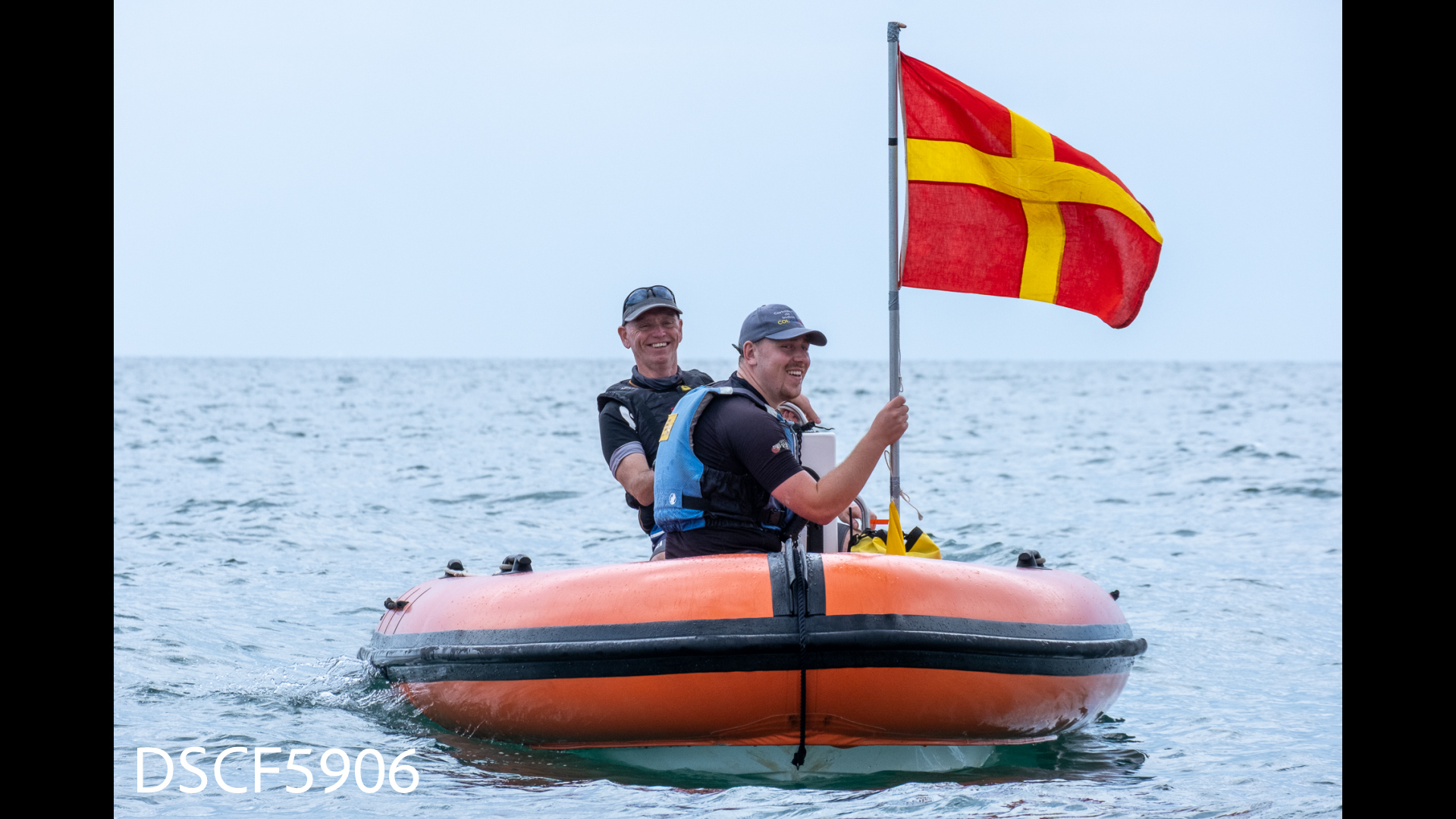
15 HP lightweight rear-steer safety boat with manual start and tilt. 1-2 crew
- Rigid rotomoulded hull; robust and resistant to damage.
- Launch and recovery require three strong adults (or equivalent), with at least two in wet gear.
- Capable of planing with up to two adults.
- CE Category C rated: suitable for up to three persons in coastal waters, large bays, and lakes, with winds up to Force 6 (27 knots) and significant wave heights up to two metres.
Quicksilver
10 HP lightweight rear-steer safety boat with manual start and tilt. 1-2 crew
- Launch requires two to three adults, with two in wet gear.
- Can be launched by one strong adult in an emergency.
- Capable of planing with one adult
- CE Category C rated: suitable for up to three persons in coastal waters, large bays, and lakes, with winds up to Force 6 (27 knots) and significant wave heights up to two metres.
Crew Competence and Qualifications
- Helm and crew shall be suitably experienced and competent for the type of boat, prevailing conditions, and intended task. An individual holding a recognised power boat qualification such as RYA Powerboat 2 is not assurance per se of competence for the conditions or type of boat in use.
- The Team Leader retains discretion to adjust boat deployment where crew numbers or competence cannot be assured regardless of qualifications held, in the interests of safety.
Boat Selection Guidance
Boat selection shall take account of wind strength and direction, sea state, number of competitors, available crew, and launch and recovery considerations.
Onshore Winds – Up to Force 4
Conditions: No significant dumping surf likely to compromise safe launch/recovery
- Use of the committee boat is encouraged.
- Races should be started from the water using flags and sound signals.
- Where the committee boat is in use, consideration should be given to deploying Quicksilver and Diamond in preference to Tyger or Barracuda.
- If Tyger or Barracuda is deployed, either Diamond or Quicksilver should be used flexibly.
Onshore Winds – Gusting Above Force 4
Conditions: Increased likelihood of dumping surf at higher tides affecting safe launch/recovery
- Use of the committee boat is encouraged unless tidal conditions introduce unacceptable launch or recovery risks.
- Tyger and/or Barracuda to be deployed as appropriate.
- For a reduced sailing fleet, Tyger or Barracuda may be deployed, with Diamond or Quicksilver used flexibly.
- Races should be started from the water using flags and sound signals unless safety considerations require both safety boats to remain fully engaged.
Offshore Winds
Conditions: Any safe racing wind strength, minimal swell
- Committee boat to be used for race starts, with the Race Officer operating from the water.
- Shore-based race office not to be used.
- Diamond crewed by two persons and Quicksilver crewed by one or two persons or alternatively replace one boat with Tyger or Barracuda where conditions are borderline.
Offshore Winds
Conditions: Any safe racing wind strength with significant swell
(Subject to safe launch and recovery conditions at the beach)
- Committee boat to be used for race starts, with the Race Officer operating from the water.
- Shore-based race office not to be used.
- Barracuda and Tyger deployed.
- Where the sailing fleet is small, reduce to one large RIB, with Diamond or Quicksilver used flexibly.
Capstan midweek sailing
In light wind and gentle sea conditions, smaller safety boats (Diamond or Quicksilver) should be used in the first instance. Operation with a single crew possessing competence to offer close-quarters support is acceptable when sea state and weather conditions allow. If there is any doubt, a larger RIB should be used.
Informal training events that do not require formal race starts
- The Committee Boat is optional and may be omitted from planning.
- Safety boat selection should still be based on prevailing conditions and resources available to launch/recover.
- The total number of boats required may increase depending on the number of vessels on the water. Small safety boats (Diamond/Quicksilver) may be used flexibly with a helm only, provided the helm can demonstrate sufficient competence to offer close-quarters support.
- For low attendance training in light conditions a single small safety boat with single helm can be used provided the helm can demonstrate sufficient competence to offer close-quarters support and the launch/recovery conditions create no safety implications.